Many people do not even know they have glaucoma
There is a need for better information and public education about this condition. In industrialised countries, the proportion of undiagnosed cases is estimated at…
News

In its mild form, Alzheimer's dementia usually shows first in the social activities of daily life, such as going out, meeting friends and family or interacting with neighbours. Over time, the instrumental activities of daily living are increasingly affected, and difficulties appear with shopping, housework, meals and managing finances. At this moderate stage, aphasia/dysphasia and apraxia may already be present. In its severe form, dementia finally reaches the basic activities of daily living, including dressing and undressing, eating and drinking, personal hygiene, toileting and transfers, together with behavioural disturbances, restlessness and a reversed day-night rhythm.
Doctors, and GPs in particular as the first medical point of contact, often encounter dementia in people over 65 (and in over half of cases it is Alzheimer's dementia). Problems in everyday life are described to them by the patient, but far more often by relatives. The question arises: how do I diagnose dementia, and when is the right time to do so? Should I treat it and, if so, how? Dr. med. Bernard Flückiger, Chief Physician of Acute Geriatrics and Internal Medicine at Spital Rheinfelden, gave an overview.
If there is an initial suspicion and the signs are also reported by a relative, it is worth enlisting that person directly for a collateral history, for example with the Informant Questionnaire on Cognitive Decline in the Elderly (IQCODE), which the person close to the patient completes: compared with two years ago, on a five-point scale, does the person have more or less difficulty remembering things about family members and friends (such as birthdays, occupations, addresses)? Do they forget what day and month it is? Do they find it harder to find things kept somewhere other than the usual place? Do they manage their finances less carefully or independently than before (transfers, banking, pension)? Spitex home-care services, care staff and attending doctors can complete the overall picture.
Of course, a proper history from the patient is also essential (especially regarding the medication they take). Three questions can already give some first indications:
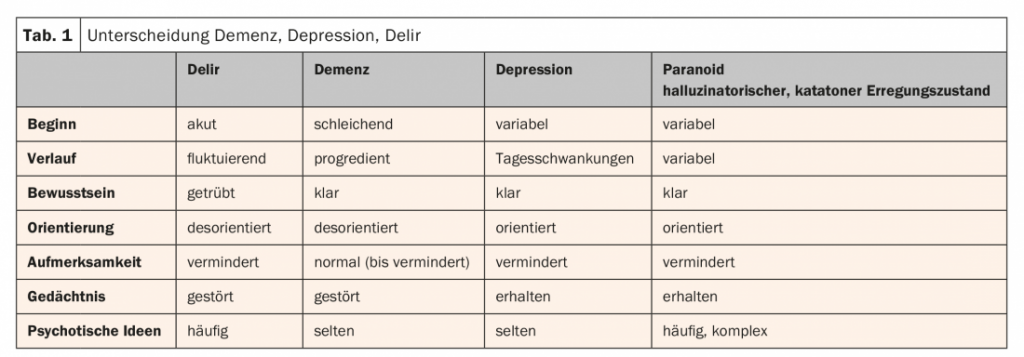
The next step is to look for specific organ disorders. Other important differential diagnoses, such as depression, delirium or psychiatric illness, may already be ruled out at this point. More likely, though, separating the three important ‘Ds’ of geriatrics, ‘dementia, depression, delirium’, will be anything but easy (Tab. 1). A geriatric assessment can help, covering mobility and gait analysis (e.g. Timed ‘Up and Go’, TUG), tests of tendency to fall (e.g. dual tasking), nutrition (e.g. Nutritional Risk Screening, NRS), mood (e.g. Geriatric Depression Scale, GDS), sensory function, a medication history and the Confusion Assessment Method (CAM, delirium-specific).
There are of course numerous tools for measuring cognition, from the clock-drawing test, which is quite sensitive at the start of dementia, to the Mini-Mental State or the MoCA (Montreal Cognitive Assessment), also a good test for early dementia. Many can easily be carried out in a GP practice.
Once the investigations are complete, all the ‘pieces of the puzzle’ have been gathered and the overall picture clearly points to early, mild dementia, one should not shy away from making the diagnosis, despite or precisely because of its devastating consequences. One thing is certain: the word ‘dementia’ carries a similar weight to ‘cancer’ and will set off an avalanche of associations, fears, apprehensions and uncertainties in everyone involved. That is why the diagnostic conversation with the patient and relatives is so important. It is a chance not only to explain the condition and its course, discuss access to specific therapies and name points of contact and important contact persons, but also to start concrete steps early and prepare the person affected and those around them for the time ahead: to train, to inform, to advise on legal and social arrangements, and so on. ‘Relatives will reach their limits at some point, which is exactly why it is all the more important to intervene early, develop strategies and provide professional support.’
If some uncertainty remains and the tests initially point not to mild dementia but to mild cognitive impairment (MCI) with possible Alzheimer's disease, the diagnostic conversation is equally helpful for explaining the suspected diagnosis and, for example, recommending an appointment at a memory clinic. Anti-dementia therapy should, admittedly, already be considered in this case too.
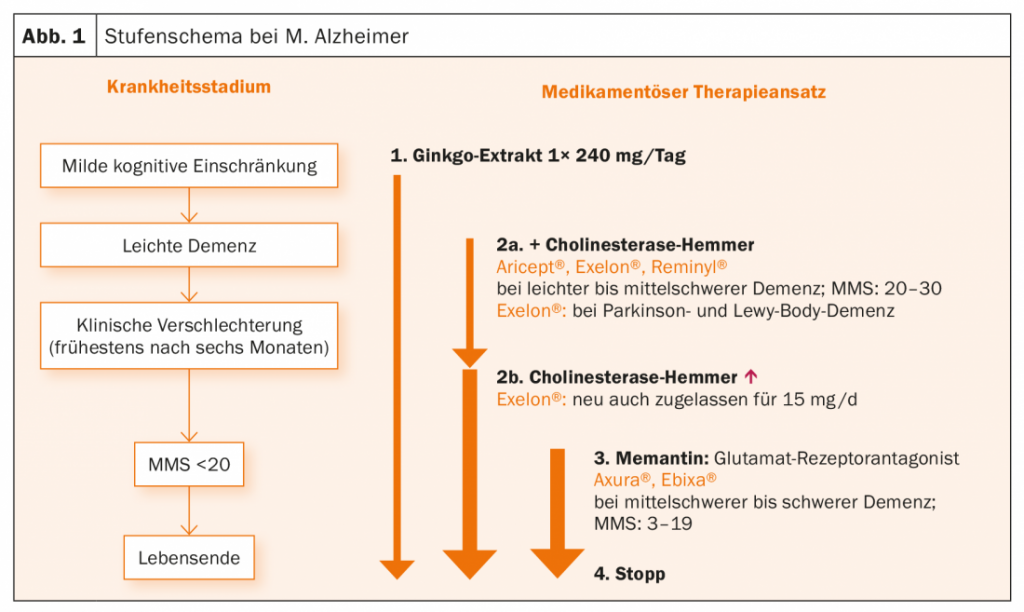
This currently looks as follows (and has done for some time): depending on the stage of the illness, ginkgo biloba extract, cholinesterase inhibitors or memantine are used (Fig. 1).‘Anti-dementia therapy should not be withheld from patients’, said the speaker. For MCI, a ginkgo biloba preparation at a dose of 1 × 240 mg/d is currently usually recommended. More recent studies in particular have clearly demonstrated its efficacy in this indication. ‘You also need not be afraid to start such a preparation in anticoagulated patients; it promotes blood flow, but is not a true antiplatelet agent. Studies have shown that the risk of severe bleeding is not increased.’ When dementia has been diagnosed, a patch can be a very sensible way of administering a cholinesterase inhibitor, provided the daily change is not a problem. This reduces the usually extensive collection of tablets that the older patient already has to take. Incidentally, these too should be reviewed regularly, i.e. every three to six months. Which medicines does the older, comorbid patient with advancing dementia still really need? Cholinesterase inhibitors delay entry to a nursing home, though not by decades, since Alzheimer's dementia ends in death after an average of ten years anyway, but by a few valuable months and years. ‘I like to give the medicines when patients show behavioural problems. They calm and stabilise. If nocturnal restlessness is the main issue, for example, Circadin® (melatonin) can also be considered. For moderate to severe dementia, memantine is finally used. Here too we observe that behavioural problems are favourably influenced (e.g. tearfulness, screaming or wandering) and neuroleptics and tranquillisers are saved.’
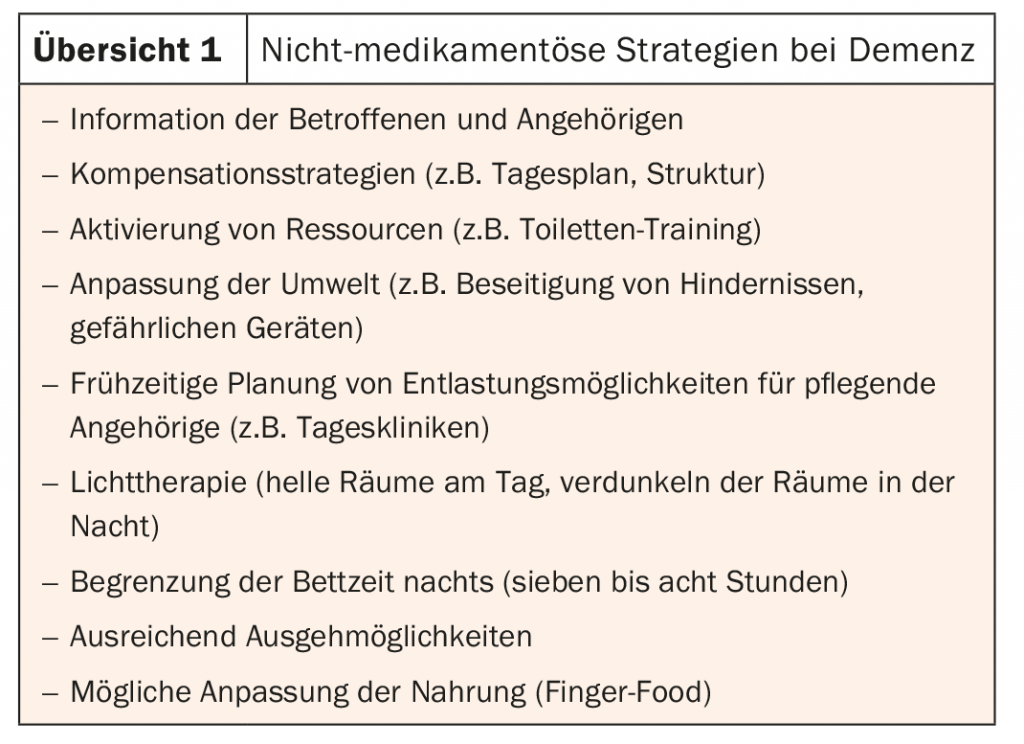
Non-drug strategies are at least as important as drug-based ones. Overview 1 summarises them.
In conclusion, then, Alzheimer's dementia is an extremely important diagnosis (not a secondary diagnosis!), and the illness itself remains a complex and intensively researched field, which gives hope for further progress in understanding its cause and treatment in the coming years.
Source: FomF Allgemeine Innere Medizin Update Refresher, 7 to 10 November 2018, Zurich
Andreas Grossmann
There is a need for better information and public education about this condition. In industrialised countries, the proportion of undiagnosed cases is estimated at…
The sudden cardiac death of an apparently healthy athlete is shocking. Despite its low incidence, work is under way on ways of detecting SCD early. Among…
Hypertension, raised blood lipid levels and diabetes are among the risk factors for CHD. As primary prevention, omega-3 fatty acid supplementation and aspirin administration…