Many people do not even know they have glaucoma
There is a need for better information and public education about this condition. In industrialised countries, the proportion of undiagnosed cases is estimated at…
News
Sudden cardiac death ('SCD') in sport means a non-traumatic death that occurs, in people with no known cardiovascular conditions, during sporting activity or at most one hour afterwards. Not infrequently, the event is preceded by warning signs, for example chest pain, shortness of breath or palpitations. People who take such signals seriously greatly improve their chances of survival. This was the finding of a survey covering ten years. Such warning symptoms are now being investigated in greater depth [1]. From a prevention perspective, this relatively new finding is of great importance.
How often does sudden cardiac death occur…?
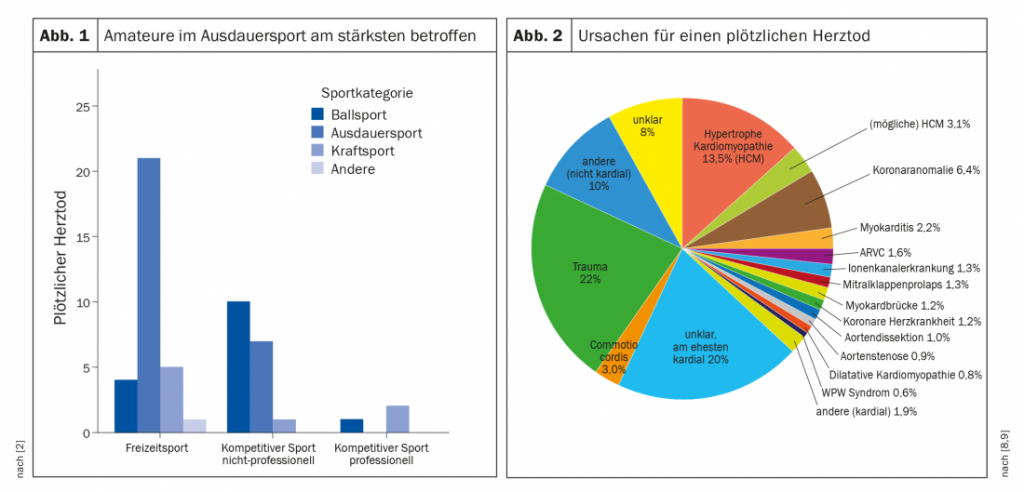
The figures found in the literature on incidence vary widely. In Switzerland, where a register for recording SCD has recently existed ('Swiss Registry of Athletic Related Death', available at www.swissregard.ch), an incidence of 0.21 per 100,000 athletes per year is cited for recreational sport and 0.57 per 100,000 athletes per year for competitive sport. These figures cannot be compared with those of African American basketball players, where the incidence is 1 in 10,000 a year [2]. It must be said, however, that the Swiss data, which cover eleven years, come from autopsies, a measure that is by no means always taken. Taking various sources into account, the incidence lies between 0.05 and about 10 per 100,000 people doing sport per year, depending on age, sex, ethnicity and sporting intensity (Fig. 1). Overall, the risk can therefore be described as low. For a person under 35, the risk of suffering SCD during sport, at a risk factor of 1–3 per 100,000, is three times lower than the risk of dying in an accident.
Figure 2 gives an overview of the most common causes of SCD. Sudden cardiac deaths caused by doping are not included. According to more recent studies, SCD is rarely due to structural causes. A Canadian analysis of 74 cases found only two hypertrophic cardiomyopathies and nothing else. It is increasingly assumed that primarily arrhythmogenic causes (without a detectable structural correlate) or ischaemic causes explain the majority of these deaths. Many cases could therefore not have been detected beforehand with the investigation methods currently available [3]. Such SCDs may be hereditary.
Even so, sports medicine examinations that could prevent at least some SCDs are discussed worldwide. In Switzerland, such check-ups have been practised for decades, and the Swiss Society of Sports Medicine (SGSM) was one of the first organisations to comment officially on the subject [4]. Such an examination should consist of a targeted medical history, a full clinical examination, a resting ECG and, depending on the situation, a blood test. For a long time there were doubts about the benefit of ECG testing, but these were dispelled by the formulation of the Seattle criteria and their further refinement [5]. A British study of interest deserves brief mention here. Between 1996 and 2016, more than 11,000 young footballers were examined periodically on the basis of the Seattle criteria. Only 7% needed additional investigation because of unclear findings, and in a third nothing pathological was found. In 42 boys, changes relevant to SCD were identified (36 of them on the ECG). During the observation period, 23 players died, eight of them from cardiac causes (two had been advised against playing sport). Six of these eight who died had shown normal values at the examinations.
The study also analysed costs and determined so-called 'costs per QALY': at £1,300, this was a fairly small amount [6]. In Switzerland too, an investigation found that the price is within a reasonable range [7]. Cost is therefore no argument for forgoing check-ups.
A personal remark in this context: SCD appears to be a field of cardiology, which is why cardiologists publish very actively on it. It would be wrong, however, to limit the sports medicine examination to a cardiological one. These check-ups, usually recommended annually, should be an occasion for a careful examination of the whole musculoskeletal system, in which the trained sports doctor has a central role, including an educational one. Healthy athletes do not have an increased risk of cardiac death, and the overall cardioprotective effect of regular physical activity is by no means in question. Preventive measures, such as informing people who do sport about the existence of the problem and a conscientiously performed sports medicine examination with ECG, can reduce the residual risk further.
Dr. med. Peter Jenoure
There is a need for better information and public education about this condition. In industrialised countries, the proportion of undiagnosed cases is estimated at…
A dementia diagnosis should not be made lightly. Among the people around the patient, it provokes about as strong a reaction as a cancer diagnosis. And yet it is important,…
Hypertension, raised blood lipid levels and diabetes are among the risk factors for CHD. As primary prevention, omega-3 fatty acid supplementation and aspirin administration…