
Many people do not even know they have glaucoma
There is a need for better information and public education about this condition. In industrialised countries, the proportion of undiagnosed cases is estimated at…

Obesity is a complex, multifactorial disease. Environmental, genetic, psychological and social factors all play an important part. Besides diet and exercise, patients' body awareness and emotional wellbeing must be taken into account. Treatment approaches that cover only one aspect generally do not do justice to the complexity of obesity [1]. That is why 'lifestyle modification' is now regarded as the treatment of choice.
Patients often have psychiatric comorbidities that either encouraged the development of obesity or arose as they gained weight, and that can help to sustain it. Eating disorders are also common. The concept of lifestyle change is not limited to non-surgical patients. It can, and indeed must, be required of bariatric patients after the operation, to prevent weight gain beyond the physiological level. International and European data on long-term weight regain after bariatric treatment exist but, surprisingly, are rarely discussed: after the operation, a regain of 10–20% of the lowest weight reached (nadir weight) is physiological [2]. This means that a regain of 8.5–17 kg is normal if a 160 cm patient with a starting weight of 120 kg reaches 85 kg after the operation. However, one in five patients gains clearly more (Adimed, n=3,256; mean observation period: 10 years). Dr. med. Renward Hauser, specialist in clinical nutrition and bariatric surgery, follows up 632 people who had surgery between 1995 and 2018. Of these, 269 patients (44.5%) have so far had a rebound of +10 to a maximum of +20% of nadir weight; 116 of those 269 patients (19.2% of all those operated on) went on to procedure failure, that is, they regained more than 20%.
An important building block of lifestyle change is behaviour modification. Patients are trained to observe and change their behaviour, and this is then repeated and built on. Further elements of behavioural therapy usually come into play as well. As well as changing the situations that trigger eating, emotional, cognitive and physical influences on eating behaviour are identified and alternative strategies derived. These are then practised with patients in everyday life. Standard interventions also include relapse prevention and the setting of long-term behavioural goals.
In everyday practice, patients often report a tendency towards 'comfort eating'. That one remark already shows how complex obesity really is. The foundations are often laid in childhood: were you often comforted with food (above all sweets) when you were sad? Did your parents make up for a lack of attention by providing food? In such cases, love and affection were often expressed and lived out through food. The lack is offset by the feeling of reward that eating brings [3]. These experiences leave a lasting mark on the rest of a person's life.
Eating stimulates the reward centre in the mesolimbic system, with a corresponding release of endorphins and dopamine, especially with foods high in fat and sugar. In this way, memory patterns are quickly established and also linked to the experiences of love, affection and comfort mentioned above. The more often these memory pathways are used, the more important they become. At the same time, always using the same 'relaxant' dulls the receptors in the reward centre, so more and more of it is needed. As the stress response also inhibits the prefrontal cortex more strongly, the organism loses conscious control; the brain goes on taking the relaxant in 'automatic mode'. When food is used to regulate emotion, this means that more and more food has to be eaten to achieve the relaxing effect, and the reflex cannot be controlled. Studies of addictive relationships with food show that about 11% of people of normal weight eat addictively, compared with around 25% of people who are overweight [4].
Newer data also suggest that predominantly emotionally triggered eating impulses can be a consequence of dieting experiences, as the body reacts to a calorie deficit with stress and impulsivity in eating behaviour. A change in the pituitary-adrenal axis, or in the response time of cortisol release, also seems to predict emotional eating [5,6]. Similar results come from research on chronic stress, which examines how biography, environment and living situation, physiological stress responses and the resulting behaviour are linked (the 'allostatic load' model) [7]. Applied to psychotherapy, this means improving patients' impulse control and emotion regulation skills. At the same time, however, patients must learn to tolerate the tension that arises when the reward stimulus is absent, and to change the circumstances that trigger eating impulses, in particular chronic stressors.
Binge eating disorder (BED), the disorder involving binge eating episodes (ICD-10: F50.9), is more common in obesity. Studies show that in conservative weight reduction programmes up to 30% of participants meet the criteria for BED [8]. Most episodes are outright eating binges in which people take in far more calories than usual within about 30 minutes. This eating behaviour is accompanied by a feeling of loss of control. Binge eating has also recently been linked to altered cortisol release. Often, though, the loss of control takes the form of snacking or grazing. This means that those affected reach only for small snacks, but do so repeatedly over a longer period. This is a frequently observed phenomenon, especially in post-bariatric patients [9]. In post-bariatric patients, particularly if concerns about figure and weight were already above average before the procedure, clinicians must also watch for anorexic patterns of behaviour and thinking.
Obesity is associated with higher rates of depression and anxiety symptoms. Data show that people with obesity, irrespective of gender, have higher rates of major depression, bipolar disorders, panic disorders and agoraphobia [10]. Data from the USA further show that depression predicts obesity. On the other hand, there are indications that increased depression in people with obesity contributes to poorer general health. An atypical subtype of depressive disorder, in which appetite and hunger appear to be increased rather than reduced, is now also under discussion. This may also lead to more emotional eating, so that patients with this subtype of depressive illness are more likely to gain weight. Patients with obesity who seek weight treatment should therefore at least be screened for anxiety and depression symptoms, as these may affect how their weight develops and, if present, need treating as well.
A weight intervention in psychiatric patients (for example chronic severe depression, schizoaffective disorders, schizophrenia) can certainly achieve lasting results on weight. Patients with chronic psychiatric illness should be treated in a multiprofessional setting. The duration of weight-related interventions seems to be a particularly important factor. Data so far show that interventions lasting less than six months had little or no effect on weight, while interventions lasting more than twelve months did produce long-term weight loss [11].
This matches our experience too: psychotherapeutic interventions start to show results after six months, combined with nutrition therapy, exercise therapy, behavioural therapy and pharmacological support. Patients who get through those six months achieve an average weight loss of 16.2% of starting weight, according to a database analysis (n=8,252) by the Zentrum für Adipositas und Stoffwechselmedizin (ZAS) Winterthur GmbH [12].
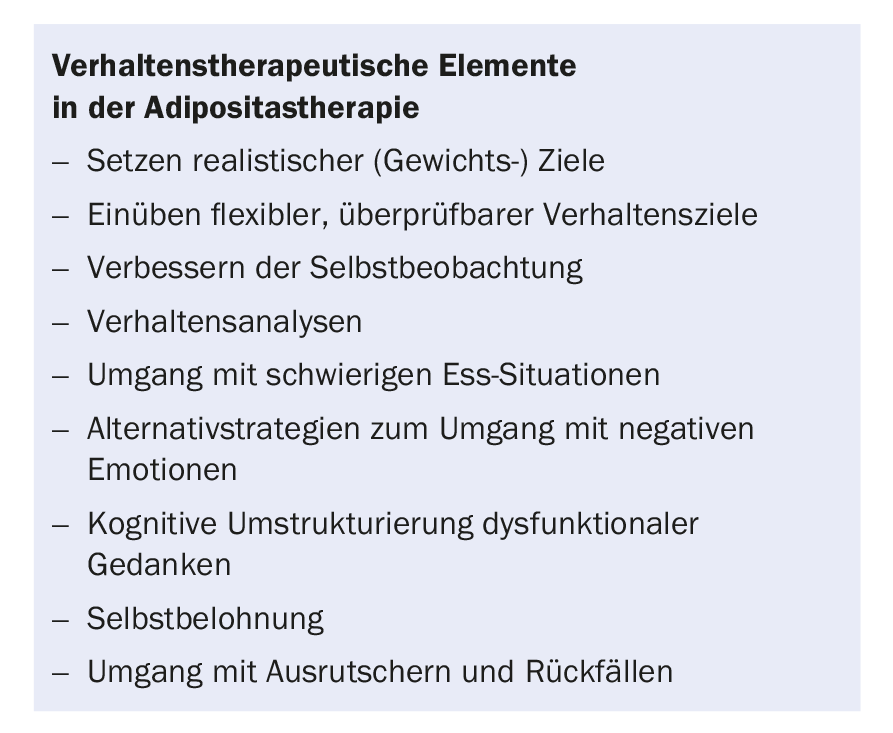
A wide range of behavioural therapy methods is suitable for general lifestyle change in obesity (see box). Behavioural approaches also give good results in BED. The top priority in treating BED is to reduce the binge episodes; only then does the focus move to actual weight reduction [13]. The methods used include self-monitoring logs, impulse control strategies and cognitive restructuring of dysfunctional thoughts about eating, figure and weight. When it comes to dysfunctional emotion regulation, it seems to make no difference whether patients complete specific emotion regulation training or are supported within a standard lifestyle change programme with behavioural psychology elements [14].
However, the ability to perceive one's own body seems to play an important role here. In line with the above, it should also be noted that parents must be closely involved when overweight children are treated. Eating behaviour is passed from parents to children.
Because obesity is a complex psycho-socio-somatic illness, however, the methods described are not enough for some patients. Approaching the problem through eating behaviour slowly makes patients aware of the underlying motive structures that drive the behaviours in question. For this reason, the weight situation often gets worse at first when weight treatment begins. In psychotherapy, this is called problem actualisation [14]. At this point, the work with patients usually has to be one to one and clarification-oriented. Patients are supported in recognising their motive structures even better and in tackling intrapsychic conflicts (conflict schemas that favour inadequate satisfaction of psychological needs). Patients thus have to learn new ways of meeting psychological needs and to accept experiences from their past.
In conclusion, psychological interventions are an important part of obesity treatment, and not only in therapy: they matter at the diagnostic stage too. The more complex the obesity and the patient's difficulties, the more a psychotherapist should be involved. In some cases psychotherapy is an indispensable part of successful weight treatment.
Roland Müller M.Sc.
Dr. med. Susanne Maurer
Dr. med. Beat R. Schaub
There is a need for better information and public education about this condition. In industrialised countries, the proportion of undiagnosed cases is estimated at…
A dementia diagnosis should not be made lightly. Among the people around the patient, it provokes about as strong a reaction as a cancer diagnosis. And yet it is important,…
The sudden cardiac death of an apparently healthy athlete is shocking. Despite its low incidence, work is under way on ways of detecting SCD early. Among…