
Many people do not even know they have glaucoma
There is a need for better information and public education about this condition. In industrialised countries, the proportion of undiagnosed cases is estimated at…
News

Triptans, which are used in the treatment of migraine, also inhibit the release of CGRP, among other things, by acting as agonists at 5-HT1 receptors. As is well known, migraine is not just a matter of headaches. Patients often feel nauseous, lose their appetite, have visual disturbances and become hypersensitive to light and noise. These symptoms are also associated with a considerable impairment of quality of life. According to Prof. Dr. med. Uwe Reuter of Charité Berlin, speaking at the German Pain Congress, it is all the more important to be able to offer these chronic patients a well-tolerated prophylaxis with few side effects. The aim of drug prophylaxis, he added, is not only to reduce the frequency, severity and duration of migraine attacks, but also to curb triptan use and other painkiller consumption, and to prevent the medication-overuse headache that can develop as painkiller consumption rises.
The criteria for chronic migraine are met if a patient suffers from headaches on at least 15 days a month, and reports migraine-type headache on at least eight of those days. In episodic migraine, by contrast, sufferers have migraine on up to 14 days a month, at intervals of varying length.
Three CGRP antibodies were shown in studies to be more effective than placebo and to lead to a significant reduction in migraine days. All three substances produce a significant therapeutic effect within the first four weeks of treatment, and are also well tolerated. Their side-effect profile is at placebo level, with the exception of reactions at the injection site. Specifically, these are erenumab, a CGRP receptor-binding antibody already approved on the European market for the prophylaxis of migraine in adults, the antibody galcanezumab, and the monoclonal antibody fremanezumab, which can be given quarterly or monthly. Two of the substances, galcanezumab and fremanezumab, target CGRP directly, while erenumab docks onto the CGRP receptor and blocks it.
No direct comparison of efficacy between the three substances is available; studies are hardly comparable because of differences in study design and duration. All three monoclonal antibodies are more effective than placebo and, in indirect comparison, as effective as the migraine prophylactics used until now.
Current prophylactic therapies were originally developed for other indications and are often associated with poor tolerability and/or insufficient efficacy, said the speaker. Beta blockers are effective in reducing migraine attacks. However, this requires high doses, around 160 mg of propranolol. 'Which patient tolerates 160 mg of propranolol?', the speaker asked provocatively. Erectile dysfunction, low blood pressure and fatigue are common at this dose. The same applies to the anticonvulsant topiramate, an alternative to beta blockers in migraine prevention. With topiramate, a dose of up to 200 mg a day is needed. At this dose, undesirable effects are often to be expected, including paraesthesia, drowsiness, insomnia, difficulty concentrating and memory problems. The usual dose prescribed in the Charité migraine outpatient clinic is 50 mg; at this dose, the efficacy of topiramate is only just above placebo.
In the prophylaxis of chronic migraine, botulinum toxin A has become established (in Germany). It is injected at a dose of 155 or 185 IU every three to four months into the forehead, temples, back of the head, neck and shoulder muscles.
With botulinum toxin A, headache days fall by eight days a month, compared with six days with placebo. The net benefit is therefore two days a month. In studies of patients with episodic migraine and an average of eight migraine days a month, treatment with erenumab brought a reduction
of about three days. The monoclonal antibody erenumab also reduces headache days in patients who have not responded to other prophylactics.
The choice of drug for migraine prophylaxis depends on its efficacy on the one hand and, on the other, on its tolerability and how likely it is to cause side effects.
'The probability of helping a migraine patient (chronic or episodic migraine) with erenumab is very high,' said Prof. Reuter, pointing to a study just published in the journal Cephalalgia [1]. It is substantially higher than with the prophylactics used until now. In addition, the number needed to harm, that is, the number of treated patients needed to produce one side effect, is at placebo level with erenumab, 13 with topiramate and 39 with botulinum toxin.
In summary, there would be no reason (other than financial) to withhold the new prophylaxis from migraine patients, said Prof. Reuter.
Table 1 shows drug prophylaxis for migraine.
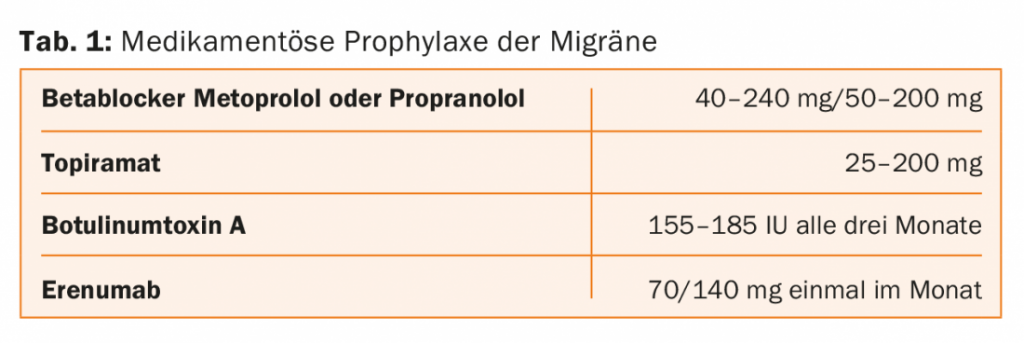
Source: German Pain Congress, 17-20 October 2018, Mannheim (Germany)
Further reading:
Dr. med. Anka Stegmeier-Petroianu
There is a need for better information and public education about this condition. In industrialised countries, the proportion of undiagnosed cases is estimated at…
A dementia diagnosis should not be made lightly. Among the people around the patient, it provokes about as strong a reaction as a cancer diagnosis. And yet it is important,…
The sudden cardiac death of an apparently healthy athlete is shocking. Despite its low incidence, work is under way on ways of detecting SCD early. Among…