
Many people do not even know they have glaucoma
There is a need for better information and public education about this condition. In industrialised countries, the proportion of undiagnosed cases is estimated at…
News

The starting point is clear: smoking endangers health. It affects not only smokers themselves but also those around them. It is equally well established that, for our patients, stopping smoking makes sense far beyond health. Many smokers would like to stop. A recent publication by the Centers for Disease Control examined data on smokers from 28 countries. Average smoking prevalence was about 23%, and around 43% of smokers had made a quit attempt in the previous twelve months [1]. It remains sobering that only about 2 to 3% of unaided quit attempts succeed [2]. Encouragingly, however, a doctor's advice to stop smoking can double that result (relative risk, RR: 1.66 [95% confidence interval, CI 1.42–1.94]) [3].
Our central role as doctors is to identify smokers in the consultation and then advise or support them accordingly. This is all the more important because about 80% of smokers see a doctor within a year.
Becoming smoke-free is often a major challenge for our patients and for us: there are larger and smaller hurdles to overcome along the way. This article aims to give practising doctors an overview of the process and treatment approaches in smoking cessation, and to suggest solutions to any difficulties that arise.
Different guidelines exist for approaching smoking cessation counselling in primary care. There is agreement that smokers must be told why stopping matters and offered supportive measures such as medication and advice on behaviour change. Figure 1 summarises the '5 A’s' strategy for stopping smoking, as recommended in the European Society of Cardiology guidelines on cardiovascular prevention in 2012 and 2016.
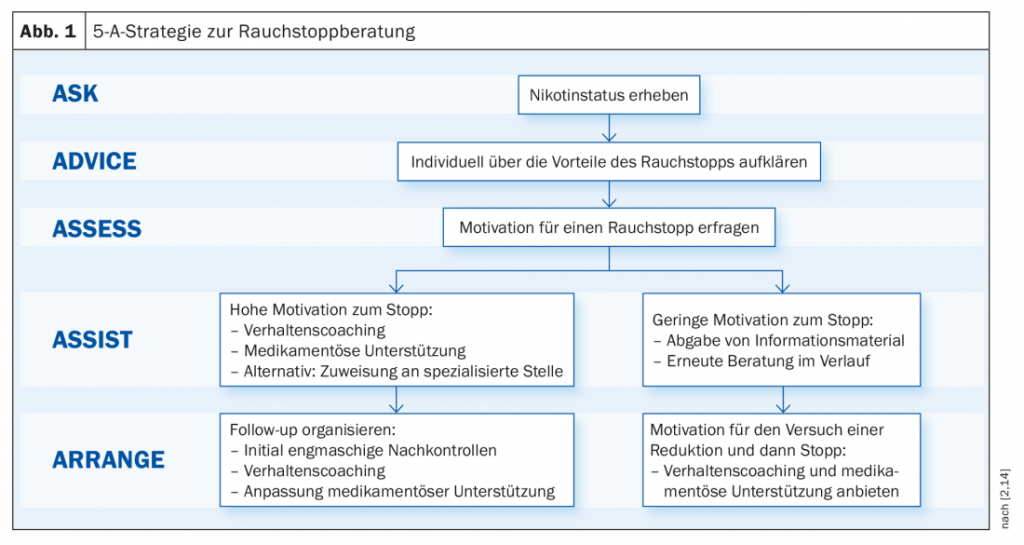
The steps 'Ask – Advise – Assess' are also known as brief intervention. They do not take much time, but they form the basis for further treatment. Specifically, they include the following steps:
The latest expert consensus of the American College of Cardiology goes one step further and recommends offering or prescribing treatment options (behavioural coaching and medication) straight away if the patient agrees [4].
The aim of the counselling conversation is to support patients in changing their behaviour from smoker to non-smoker. The technique of 'motivational interviewing' has proved an effective tool for this [5]. This counselling style is based on encouragement and support rather than argument and persuasion. It aims to create a positive interpersonal atmosphere that prepares the ground for behaviour change.
In essence, this means meeting the patient with empathy and support, as an equal, and accepting their point of view. Contrary to popular belief, deterrent or fear-inducing statements generally have little effect and tend to damage the doctor-patient relationship. Resistance should not be countered with counter-arguments but understood as a signal that the patient is telling us where their limits lie. It then helps to support the patient in clarifying their ambivalence, so as to move them forward in making a decision. The treating doctor's role is to understand the patient's standpoint, without necessarily having to approve of it. It is advisable to highlight the individual benefits of stopping smoking and to avoid reproach or judgemental remarks about their behaviour. The motivation to change lies within the patient and should be drawn out and strengthened. Examples of conversations on handling resistance can be found in Table 1.
How the conversation opens often decides whether we can have an open discussion. The opening therefore plays an important part (see opening questions in Table 1).
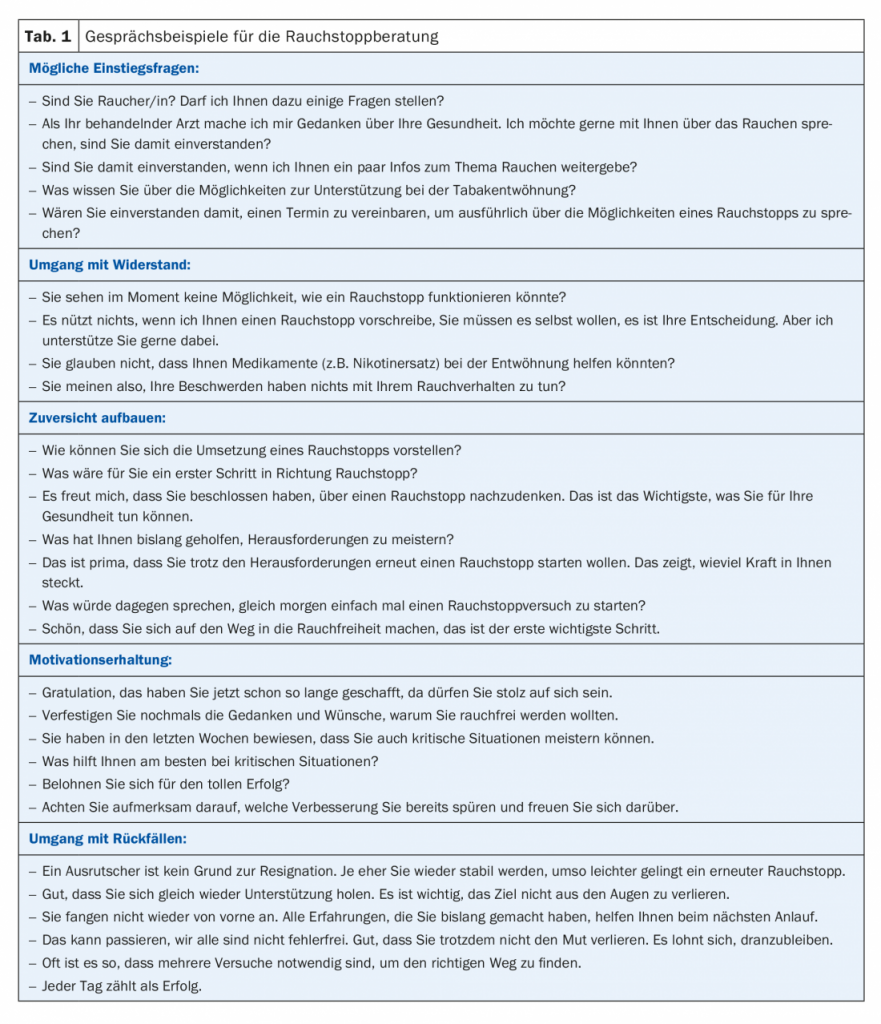
Despite great determination, attempts to stop smoking often end in relapse, which many of our patients find frustrating. Building motivation and confidence is therefore an important part of counselling (Table 1). Explaining that lasting success usually follows several attempts often helps to counter frustration. It can also help to explain the effect of nicotine and the dependence potential that comes with it, and to talk about possible withdrawal symptoms. This also increases willingness to accept additional drug treatment.
Regular follow-up appointments to support cessation should be part of every treatment. Their purpose is to work out coping strategies for staying abstinent and so prevent relapse. Potential high-risk situations should be discussed so that patients can anticipate them and develop behavioural strategies for them (avoiding triggers, waiting, distracting oneself, resisting, and so on). The effect of the medication should also be reviewed and adjusted if necessary. The following schedule is recommended for follow-up appointments: 1, 2, 4 and 8 weeks; 3, 6 and 12 months.
A good counselling conversation is a fundamental pillar of patient management in smoking cessation. As mentioned at the start, combining counselling with medication is more effective for stopping smoking than counselling alone or medication alone. Counselling and drug treatment should therefore be offered together whenever possible.
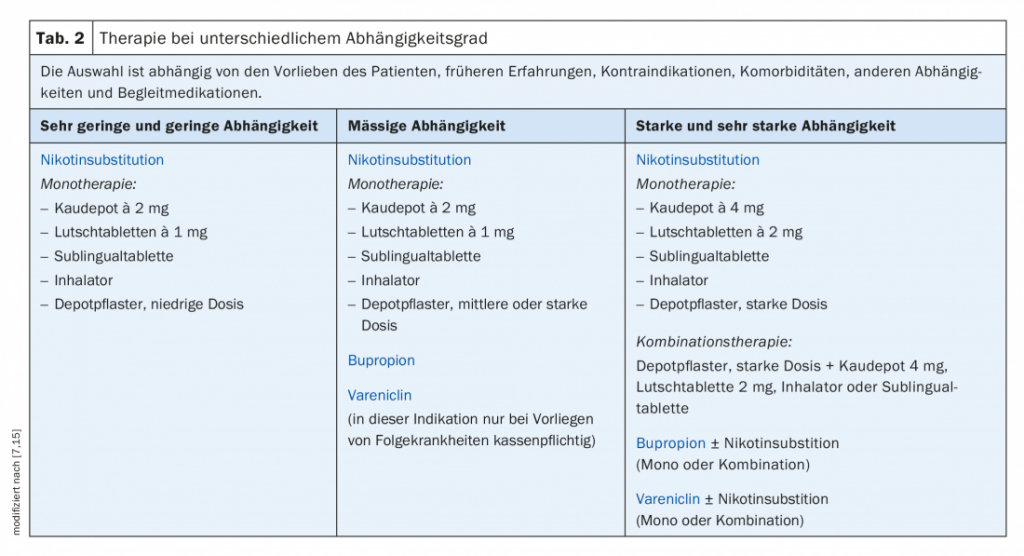
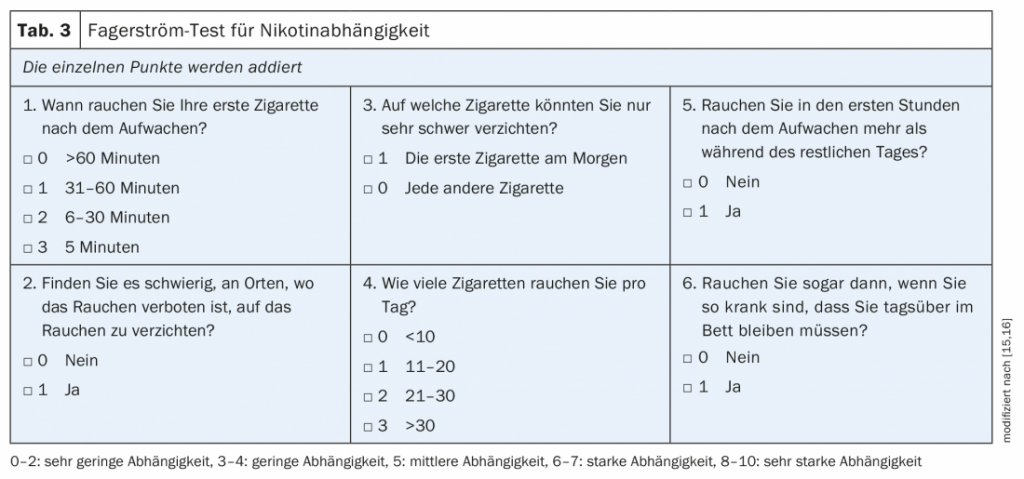
Three groups of medication are available as pharmacological aids for stopping smoking: nicotine replacement products (NRT), varenicline and bupropion. All three are more effective than placebo for achieving smoking cessation after six months [4]. The choice of product depends on the strength of the dependence, which can be assessed with the Fagerström test (Table 2 / Table 3), and on the user's preference. With NRT in particular, it is important to choose a high enough dose and to plan a long enough course of therapy.
Nicotine replacement products: NRT is available in different forms. A distinction is made between short-acting products, such as lozenges or inhalers, and long-acting forms such as patches. The combination treatment, a long-acting baseline therapy (patch) supplemented by short-acting as-needed therapy, achieves the highest effectiveness [6]. The absence of absolute contraindications is a considerable advantage of NRT.
Varenicline: this drug has a dual mode of action at the nicotine receptor in the brain. The partial agonist stimulates the receptor partially, which reduces withdrawal symptoms. At the same time, an antagonistic effect arises, shown by the absence of any effect when nicotine is consumed alongside. Patients can keep smoking during the first two weeks of treatment, and in that time many find smoking changed and less rewarding. The most common side effects are gastrointestinal complaints such as nausea. This can be countered by increasing the dose slowly or by taking the medication with a small meal. Varenicline must not be used during pregnancy or breastfeeding. In terms of effectiveness, varenicline is on a par with an adequate combination therapy of short- and long-acting NRT and superior to bupropion or NRT on its own [6].
Bupropion: this atypical antidepressant can also be used to support smoking cessation. It works by inhibiting the central reuptake of dopamine and noradrenaline. Compared with the two substance classes above, it has a less favourable side-effect profile, a greater potential for interaction with other medication and also lower effectiveness [6].
Table 2 gives a practical overview of how the medications are used. For more information on the scope of application, we refer to the Swiss recommendations for tobacco cessation [7,8] and to the compilation 'Medical smoking cessation counselling' [9].
For adults who are dependent on tobacco, are motivated to stop smoking and receive support from a medical professional, the health insurer covers twelve weeks of treatment with varenicline and seven weeks of treatment with bupropion, provided there is either a tobacco-related disease or severe nicotine dependence (Fagerström test ≥6). After a relapse, the health insurer pays for medication costs again after 18 months at the earliest.
If motivation is lacking: if the patient is not ready to stop smoking, we can hand out information leaflets and ask for their agreement to raise the subject again at a later date. A brief intervention also counts as a success if it raises awareness of the problem or leads the patient to consider a change in behaviour in the foreseeable future.
For patients who are not yet ready to stop but are willing to cut down on cigarettes, we can still begin drug treatment on a trial basis. One study looked at the effect of varenicline on smoking cessation in patients willing to reduce their cigarette consumption. It found that 24 weeks of varenicline significantly increased quit rates after one year compared with placebo (27.0% in the varenicline group vs 9.9% in the placebo group; risk difference, RD: 17.1% [95% CI 13.3–20.9%]; RR: 2.7 [95% CI 2.1–3.5]) [10]. A 2008 meta-analysis had already shown similar results for nicotine replacement therapy (NRT) [11]. A trial of drug treatment can therefore make sense even for smokers who are not highly motivated to quit. The American College of Cardiology currently recommends this more proactive use of medication as well [4].
Smokers should also be made aware of why a smoke-free environment matters for their relatives, especially children (keywords: smoke-free home, smoke-free car).
By no means all patients achieve lasting tobacco cessation. Whenever possible, we should use a relapse to keep motivating patients to quit (Table 1). Relapses can help to identify high-risk situations and to work out strategies for coping with a similar situation next time.
It is common for patients to manage a marked reduction in cigarette consumption but then get stuck at a small number of cigarettes a day. In this situation the medication can be stepped up, for example through combination therapy. In particular, varenicline can be supplemented with NRT (patches, short-acting forms of delivery), as can bupropion [4].
As a last resort, after several frustrating attempts to quit or where there is no motivation at all to stop, an e-cigarette can be a reasonable option as a form of harm reduction. It is important, however, to switch completely; otherwise harm is not really reduced. Over the past year, several studies have shown that even a small number of conventional cigarettes a day carries a substantial health risk. According to a study by Hackshaw et al., smoking just one cigarette a day still carries half the cardiovascular risk of smoking 20 a day [12]. Merely cutting down on conventional smoking therefore brings less benefit than assumed, especially for cardiovascular complications. Another study showed that occasional smokers who smoke fewer than one cigarette a day also have higher mortality than non-smokers [13].
Dr. med. Andrea Meienberg
Uta Engler
Silvia Caviola
Dr. med. Thilo Burkard
There is a need for better information and public education about this condition. In industrialised countries, the proportion of undiagnosed cases is estimated at…
A dementia diagnosis should not be made lightly. Among the people around the patient, it provokes about as strong a reaction as a cancer diagnosis. And yet it is important,…
The sudden cardiac death of an apparently healthy athlete is shocking. Despite its low incidence, work is under way on ways of detecting SCD early. Among…