Many people do not even know they have glaucoma
There is a need for better information and public education about this condition. In industrialised countries, the proportion of undiagnosed cases is estimated at…
News
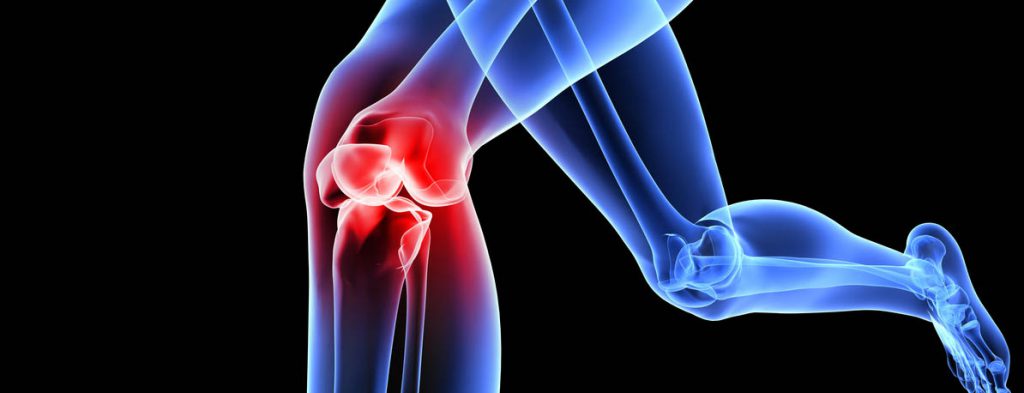
Since the beginning of the 20th century, average life expectancy in industrialised countries has almost doubled, thanks to better nutrition, hygiene and healthcare. The flip side is that the human body now has to work at its best for twice as long, and this falls above all on the muscles and joints, the main mechanical elements of movement. The high prevalence of osteoarthritis shows that this cannot be taken for granted, and our understanding of the condition is changing rapidly. What was long seen as simple wear and tear of the articular structures (especially the cartilage) is now increasingly understood as a complex inflammatory disease affecting the whole joint, including adjacent structures (and possibly with a systemic component).
The aetiological processes that lead to osteoarthritis are multifactorial. Genetic factors play a part, and so do lifestyle factors. Genetic predisposition cannot be influenced, but lifestyle factors can be changed to a certain extent. Physical activity is a modifiable lifestyle factor: it can help to prevent and protect against osteoarthritis, but it can also be a risk factor. Above all, the intensity and type of load decide whether the effects tend to be positive or negative.
The amount of stress on the body varies with the type and intensity of movement. When walking, the load on the hindfoot is 1.2 times body weight; when jogging at an easy pace it is 2.4 times body weight. For a person weighing 70 kg, that means a load of 2.52 tonnes per 8,000 to 10,000 steps (the lower limit for a health-promoting effect), which extrapolated over a year comes to 858,480 tonnes. With loads like these, it is no wonder that various structures of the musculoskeletal system begin to protest! Does sporting activity therefore open the door to osteoarthritis?
The evidence on sport and osteoarthritis is surprisingly good: a number of publications have appeared, and by and large they reach the same conclusion [1]: sport is both a risk factor and a protective factor for osteoarthritis. The main risks are acute injuries, which clearly contribute to the development of osteoarthritis. For example, the likelihood of developing knee osteoarthritis rises exponentially after a meniscectomy or after surgery following a rupture of the anterior cruciate ligament.
By contrast, there is no evidence of an increased risk of osteoarthritis in people who do sport at 'normal' intensity compared with people who do none. The risk of developing osteoarthritis therefore appears to be higher only in people who follow a very intensive sports programme. It is easy to see why running 100 km a week on tarmac is not purely good for the joints. When assessing an individual's possible osteoarthritis risk, it is therefore essential to know the sport, the training intensity and how much load the joints take.
Unlike secondary osteoarthritis, which can usually be treated at its cause, primary osteoarthritis can be treated in many ways: analgesics (e.g. NSAIDs, opioids), SYSADOA ('symptomatic slow acting drugs in osteoarthritis') and DMOAD ('disease modifying osteoarthritis drugs'), topical medicines, new substances (strontium ranelate, anti-NGF, cathepsin inhibitors etc.), intra-articular applications (glucocorticoids, viscosupplementation, PRP ['platelet-rich plasma']), 'chondroprotective agents' (chondroitins, glucosamines), taping, biomechanical shoes for load distribution, orthoses to reduce biomechanical joint loading, physical therapies (cold, heat, electrotherapy), patient information, weight reduction, physiotherapy, physical activity etc.
We will now look more closely at the last two options (physiotherapy and physical activity). Physical activity is important in the treatment of osteoarthritis. As for all structures of the musculoskeletal system, the rule 'use it or lose it' also applies to the joint elements affected by osteoarthritis (bone, cartilage, synovial membrane, menisci and even ligaments and nearby tendons): what is not challenged wastes away. It is important that people with osteoarthritis-related pain or restricted movement stay physically active too. There is scientific evidence that an exercise programme to improve cardiovascular health also has positive effects on factors relevant to osteoarthritis and on psychosocial factors, and can also help with weight loss. Weight control matters above all for knee osteoarthritis and seems less relevant for hip osteoarthritis [2]. More recent findings also suggest a link between obesity and inflammatory processes mediated by interleukins (IL-6) [3].
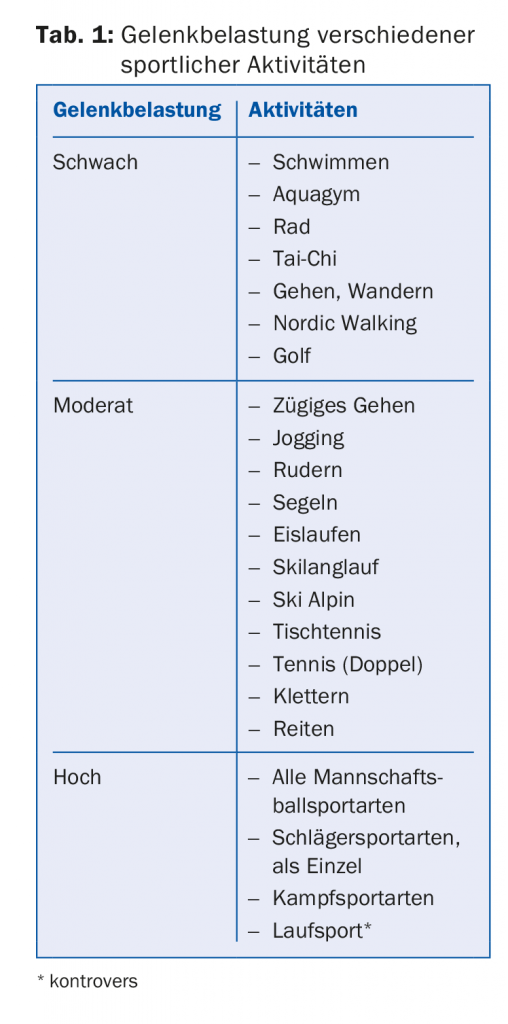
In summary, sport and osteoarthritis are not mutually exclusive; what matters is choosing a suitable activity. Sports with smooth (as opposed to abrupt) movements are particularly well suited. With osteoarthritis in the upper limbs, striking and throwing movements should be avoided. If the lower limb is affected, on the other hand, impact loading and strong rotational forces should be avoided. Table 1 lists sporting activities by the degree of load they place on the joint.
Dr. med. Peter Jenoure
There is a need for better information and public education about this condition. In industrialised countries, the proportion of undiagnosed cases is estimated at…
A dementia diagnosis should not be made lightly. Among the people around the patient, it provokes about as strong a reaction as a cancer diagnosis. And yet it is important,…
The sudden cardiac death of an apparently healthy athlete is shocking. Despite its low incidence, work is under way on ways of detecting SCD early. Among…