Many people do not even know they have glaucoma
There is a need for better information and public education about this condition. In industrialised countries, the proportion of undiagnosed cases is estimated at…
News
Vitamin D is unusual in human nutrition: with sufficient sunlight the skin can produce it endogenously, but it can also be taken in exogenously through food and supplements. Vitamin D is a fat-soluble vitamin found in plant foods as vitamin D2 (ergocalciferol) and in animal foods as vitamin D3 (cholecalciferol). Together with dietary fats, these calciferols are transported from the gut in chylomicrons via the lymph to the liver.
In human skin, vitamin D3 can be produced by UVB radiation with a wavelength of 290–315 nm. In Switzerland, however, endogenous vitamin D3 production is insufficient in the winter months, so around 60% of the Swiss population do not get enough vitamin D during this period. The shortfall then has to be made up through food.
Together with calcium, vitamin D plays a decisive role in calcium and phosphate metabolism. Vitamin D is also involved in preventing various chronic diseases, as its active form contributes to more than 6,000 gene expressions. In older age, both the absorption of vitamin D through the gut and its production in the skin decline. As a result, osteoporosis occurs more often.
Foods contain relatively little vitamin D. The exceptions are oily fish, high-fat hard cheeses, some mushrooms and egg yolk. According to the D-A-CH reference values, older people (aged 65 and over) should take in 20 μg (800 IU) of vitamin D a day. This takes into account the reduced synthesis in the skin in older age. The threshold for undersupply is taken to be a blood plasma level of 50 nmol/l of the active form of vitamin D, 25-hydroxyvitamin D [11]. However, different methods can give different results. To minimise the risk of falls, people aged 60 and over should have 25(OH)D concentrations of ≥75 nmol/l.
Calcium is especially important for bone health. Almost 100% of the body's calcium store is held in the bones and teeth. The calcium requirement of 1,000 mg/day for people aged 65 and over can be met with an average diet. However, calcium can only be absorbed and built into the bones with the help of vitamin D. Supplements combining calcium and vitamin D therefore make sense. The ongoing DO-HEALTH study, one of Europe's largest studies on ageing, is run at the University Hospital Zurich and is investigating how we can age healthily and actively [2,3]. Led by Prof. Heike Bischoff-Ferrari, the study examines three strategies: the effect of vitamin D3, the effect of omega-3 fatty acids (from marine algae) and a home exercise programme. Final results are expected in mid-2019.
From birth to adulthood, the human body stores 30 to 35 times as much calcium in the skeleton, its largest calcium reservoir. Vitamin D is indispensable for building bone, however [4]. Humans reach peak bone density at around the age of 30, after which bone mass and density decline. Bone loss is slow, steady and painless. The larger the calcium store (high bone density) built up in youth, the later osteoporosis sets in. The process of bone loss cannot be stopped, but it can be slowed [5]. Exercise, time outdoors (in the sun) and an adequate dietary supply of vitamin D, calcium, phosphorus and protein count most here [6].
Myopathy is regarded in older age as a classic symptom of severe vitamin D deficiency. The consequences are muscle pain, muscle weakness and gait disturbances, which are reversible with vitamin D supplementation [4].
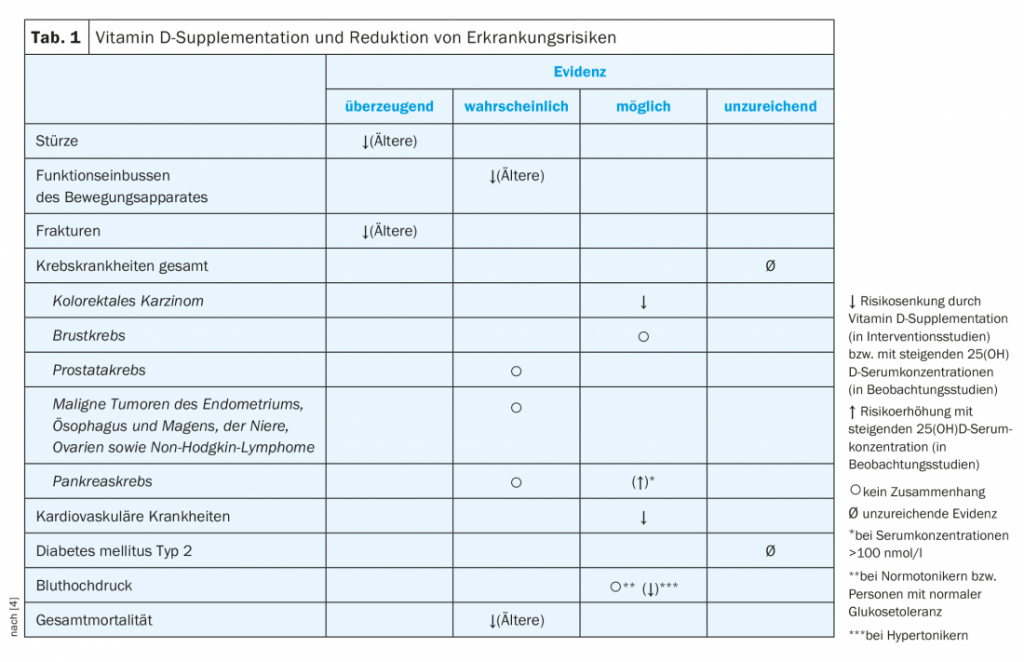
In older age, muscle mass and bone density decrease while the risk of falls rises; around 90% of all fractures in older age are caused by falls. Various meta-analyses and controlled studies have shown links between a lower risk of falls and supplementation with vitamin D and calcium [7,8], and have also documented positive effects on the functional musculature [4]. Possible links between an increased risk of cancer, diabetes or high blood pressure and vitamin D supply are currently unclear, however. A link between cardiovascular events and vitamin D supply, by contrast, is regarded as probable [4]. Various studies suggest a correlation between a reduction in all-cause mortality and vitamin D supplementation [4] (Table 1).
By quantity, calcium is the body's most important mineral. Almost 100% of it is stored in the bones and teeth. The recommended calcium intake is currently 1,000 mg/day. However, calcium can only be absorbed from the gut with the help of vitamin D. The recommended amount can easily be reached with a balanced diet [9]. Milk and dairy products, broccoli, kale and rocket as well as mineral water are important sources of calcium [10–12] (Table 2).
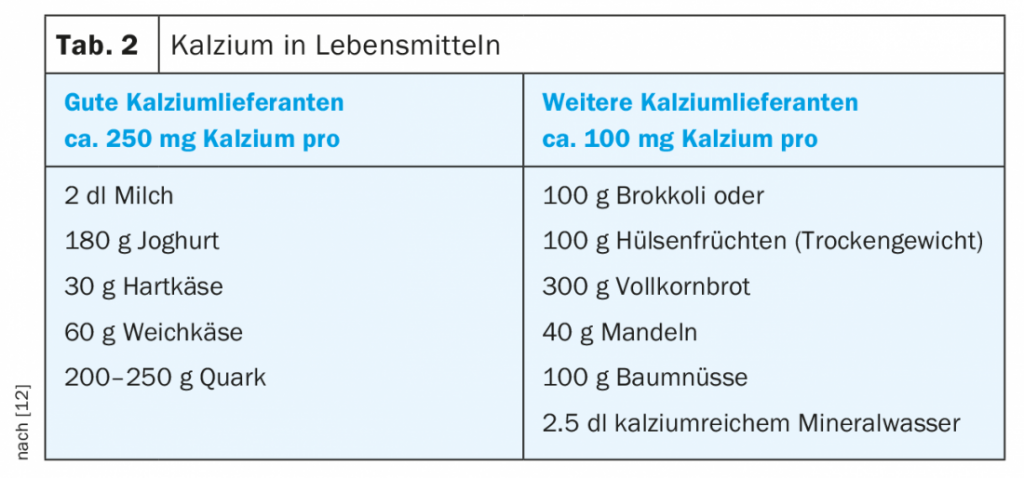
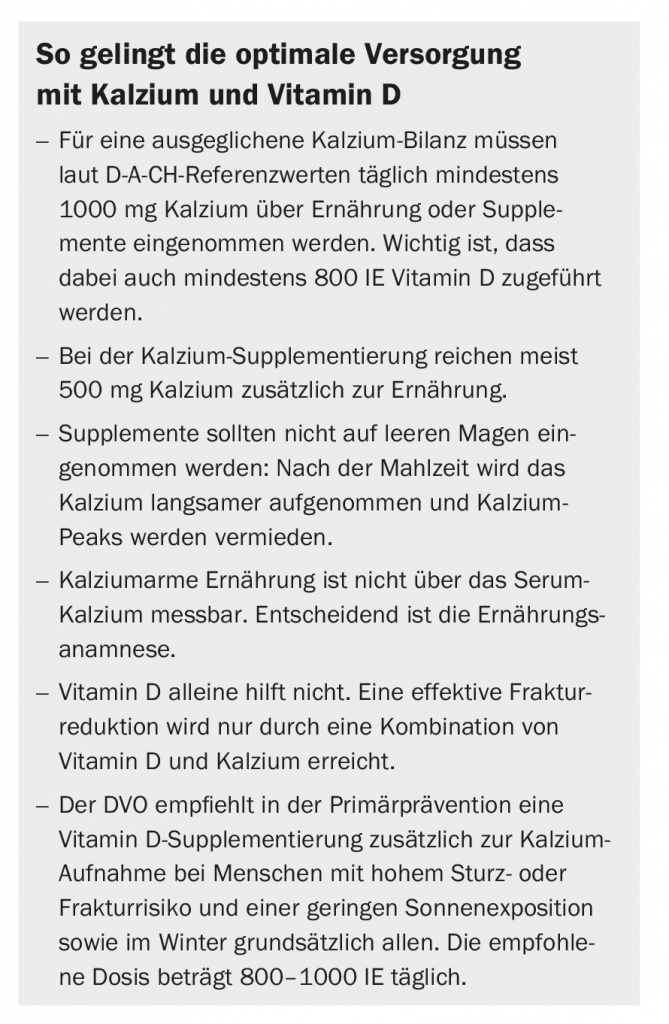
The guidelines of the Dachverband Osteologie (umbrella association for osteology) recommend a daily intake of 1,000 mg of calcium for general osteoporosis and fracture prophylaxis in postmenopausal women and in men from the age of 60. For people at high risk of falls and fractures and with little sun exposure, they recommend an additional 800–1,000 IU of vitamin D a day [13]. The D-A-CH reference values for nutrient intake give similar recommendations [1].
For calcium to be deposited in the bones as effectively as possible, exercise is essential, preferably outdoors in sunlight. The exercise should demand muscle strength so that it stimulates the build-up of bone mass. The WHO recommends walking at least 10,000 steps a day, which corresponds to one hour of physical activity in daily life. Risk factors such as being underweight, smoking and excessive alcohol consumption should be avoided.
Some foods should be eaten less, because they upset the body's phosphate-calcium balance and can thereby have a negative effect on bone health. Foods and stimulants to cut down on where osteoporosis is present include:
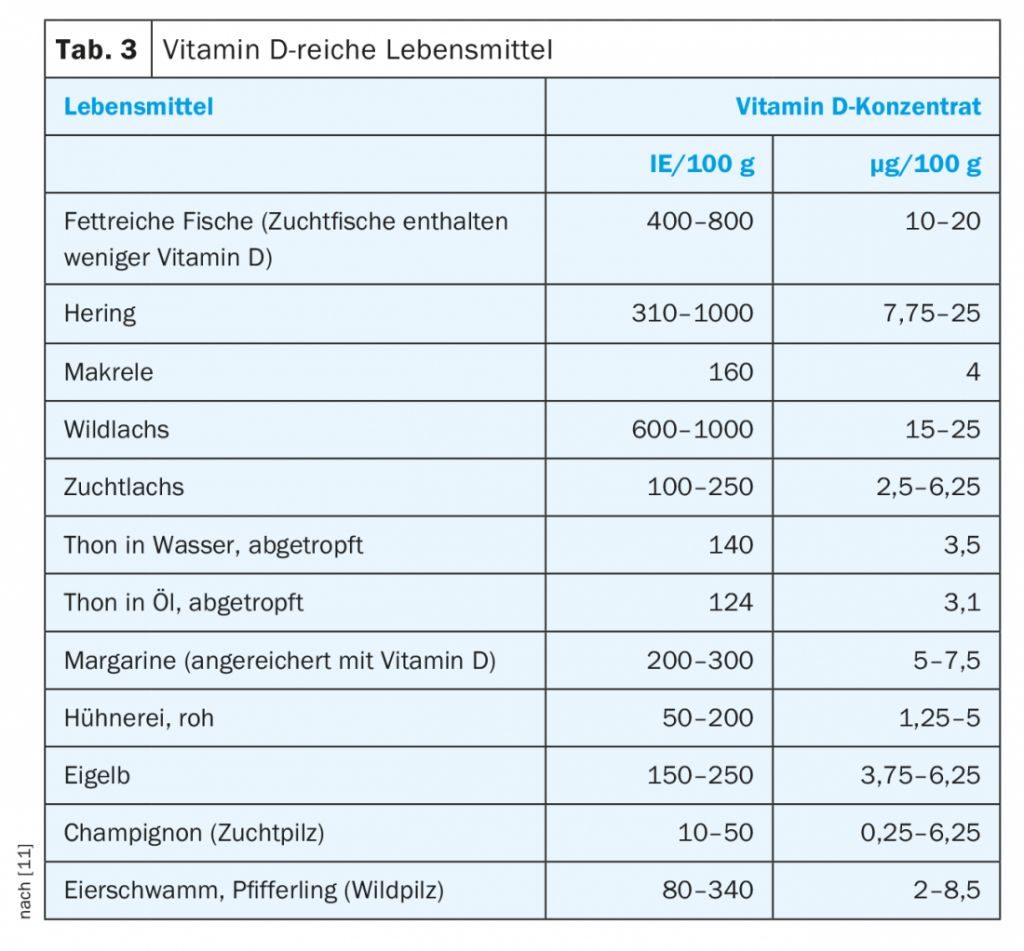
Table 3 gives an overview of beneficial foods. The tips in the box show what needs to be considered to ensure an adequate supply of calcium and vitamin D.
Prof. Dr. Christine Brombach
There is a need for better information and public education about this condition. In industrialised countries, the proportion of undiagnosed cases is estimated at…
A dementia diagnosis should not be made lightly. Among the people around the patient, it provokes about as strong a reaction as a cancer diagnosis. And yet it is important,…
The sudden cardiac death of an apparently healthy athlete is shocking. Despite its low incidence, work is under way on ways of detecting SCD early. Among…