Many people do not even know they have glaucoma
There is a need for better information and public education about this condition. In industrialised countries, the proportion of undiagnosed cases is estimated at…

Between 20 and 25% of healthy people have a patent foramen ovale (PFO), but only 2% have symptoms. Although the number of strokes caused by PFO is small overall, younger stroke patients (under 55) in particular have an increased risk of a cryptogenic ischaemic stroke if a PFO is present. PFO-triggered strokes are thought to be caused by paradoxical emboli, in which thrombi pass from the venous into the arterial system. Diagnosis is by exclusion. Where PFO is suspected, transoesophageal echocardiography is the imaging method used.
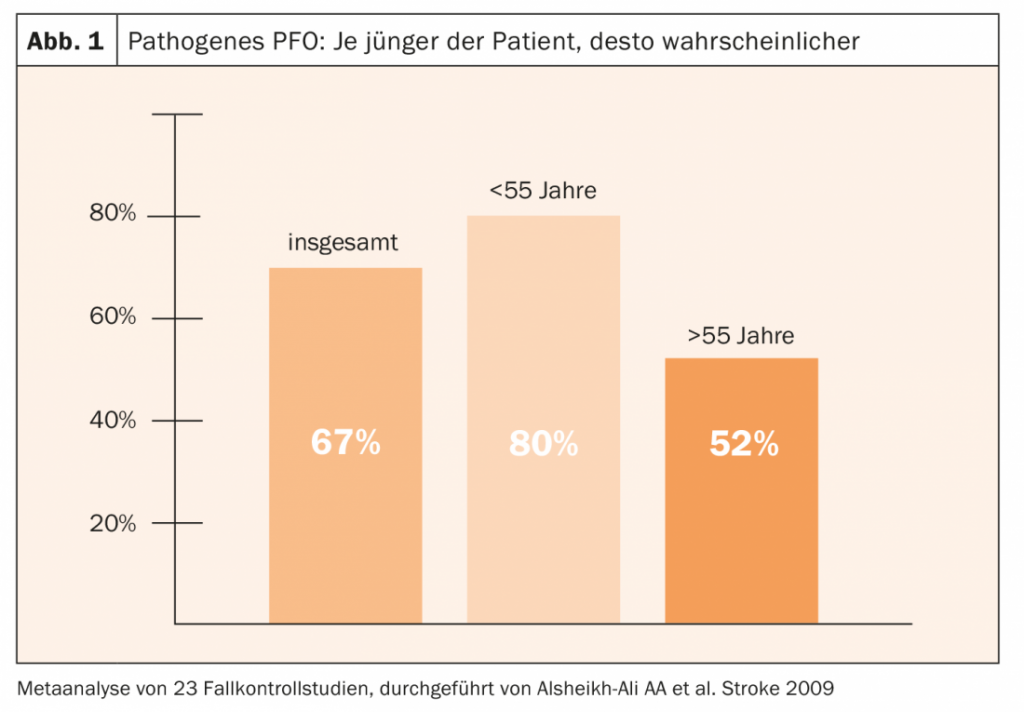
According to a meta-analysis, an average of 67% of people with a PFO have a pathogenic one. Younger patients are at higher risk than older ones (Fig. 1). A pathogenic PFO is characterised by an increased right-to-left shunt and an atrial septal aneurysm. A low burden of cardiovascular risk factors combined with younger age also points to a pathogenic PFO. Clinical clues can also come from the context, for example circumstances that suggest a paradoxical embolism: neurological symptoms on waking, migraine, phlebothrombosis or pulmonary embolism, sleep apnoea or a preceding Valsalva manoeuvre. Because this diagnosis is so difficult, like looking for a needle in a haystack, close cooperation between the neurologist and the cardiologist is essential.
In general, the risk of recurrence in stroke patients with a PFO varies greatly from one individual to another and is therefore hard to predict. A repeat stroke is more likely with older age, a septal aneurysm, the use of aspirin instead of oral anticoagulants, coagulation disorders and a larger PFO diameter.
Stroke patients with a PFO can currently be treated with antiplatelet therapy (APT), anticoagulation or PFO closure, although closure does not rule out long-term medication. But which route is best, and for whom?
Whether interventional occluder closure reduces the risk of recurrence in stroke patients with a PFO compared with drug therapy alone is the subject of numerous studies.
Three older RCTs, CLOSURE-I (2012), PC-Trial (2013) and RESPECT (2013), showed no advantage for occluder closure in their primary endpoints over a relatively short follow-up period. In each, however, the intervention arm had a lower event rate than the control group on drug treatment. In the per-protocol analysis of the RESPECT trial, the reduction in events in the intervention group was significant.
Three more recent studies have since demonstrated that occluder closure is effective in reducing the risk of recurrence in patients under 60 with cryptogenic stroke. What made the difference was the longer follow-up, the inclusion of high-risk PFOs (large shunt volume, atrial septal aneurysm), the exclusion of patients with transient ischaemic attacks and lacunar infarcts, a lower burden of cardiovascular risk factors and the use of second-generation devices (‘double disk devices’).
The three-arm CLOSE trial (2017) examined the treatment effect of PFO closure versus anticoagulation versus APT in patients aged 16 to 60 with a PFO and cryptogenic stroke. In a 1:1:1 ratio, 663 patients were randomised to three groups and treated with PFO closure plus APT, APT alone or oral anticoagulation. The primary endpoint was stroke. Over the observation period of 5.3 years, no stroke occurred in the occluder group, whereas there were 14 cases in the APT group (HR 0.03; 95% CI 0–0.26; p=0.001). Comparing anticoagulation with APT, there were three strokes versus seven. There was therefore no significant difference between anticoagulation and APT, while occluder therapy proved superior overall.
REDUCE (2018) compared the treatment success of PFO closure plus APT with APT alone in 664 patients over an observation period of 3.2 years. Recurrent ischaemic strokes occurred in 6 of 441 patients in the occluder group against 12 of 223 patients in the APT group, which corresponds to an HR of 0.23 (95% CI 0.09–0.62; p=0.002). New silent infarcts were about equally frequent in both groups.
DEFENSE-PFO (2018, n=60) also pointed to the benefit of an occluder: after two years of follow-up, the primary endpoint had been reached in six patients in the drug treatment arm but did not occur in the intervention group. The long-term results of the RESPECT trial, published in 2017 after an observation period of six years, are also encouraging.
Taken together, the results show a relative reduction in the stroke recurrence rate of around 75% when PFO closure is performed. This applies only to patients under 60 with a medium to large right-to-left shunt. Whether patients over 60 also benefit from closure remains unclear for lack of data.
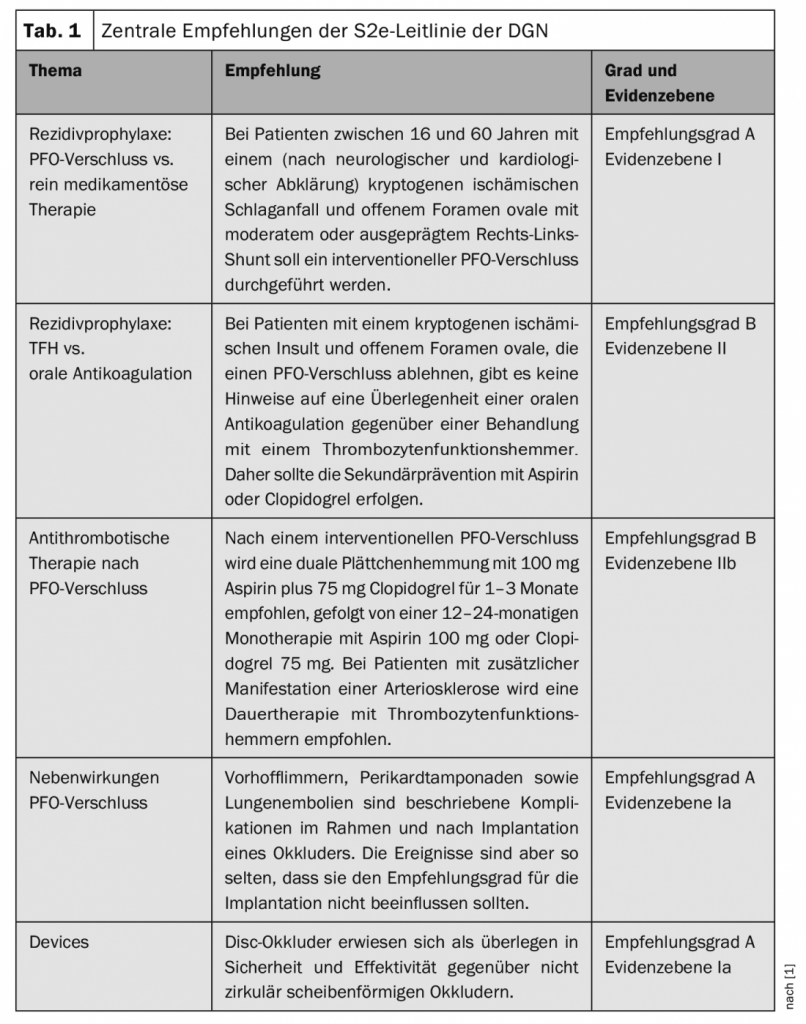
On the basis of these findings, the German Society of Neurology (DGN), the German Stroke Society (DSG) and the German Cardiac Society (DGK) have drawn up a new guideline [1]. It is aimed at both neurologists and cardiologists. The key recommendations are summarised in Table 1.
The occluder procedure is considered safe. Complications during the operation occur in 2.6% of cases, and long-term mortality or the risk of heart surgery is <0.1%. The most common late complication, at 1–2%, is device thrombosis. Atrial arrhythmias occur in 0.5–15% of cases, mostly during the first 45 days after the operation (self-limiting). Pericardial effusion and cardiac tamponade are dangerous but not common, at 0.5–1%. In about 10–15% of patients the shunt remains. The best results in this respect in studies were achieved by the AMPLATZER® occluder (PC-Trial, RESPECT, DEFENSE-PRO). GORE® HELEX (REDUCE) and GORE® CARDIOFORM (REDUCE) are also recommended.
There are currently no studies focusing on postoperative management. Based on the available data, however, dual APT is advisable for 1–6 months after closure. Single APT should then continue for five years to minimise the risk of device thrombosis. In addition, antibiotic prophylaxis should be considered if an invasive procedure is planned within the first six months after PFO closure.
Barbara Hug
There is a need for better information and public education about this condition. In industrialised countries, the proportion of undiagnosed cases is estimated at…
A dementia diagnosis should not be made lightly. Among the people around the patient, it provokes about as strong a reaction as a cancer diagnosis. And yet it is important,…
The sudden cardiac death of an apparently healthy athlete is shocking. Despite its low incidence, work is under way on ways of detecting SCD early. Among…